Postal Ceasefire
Grey BeesThe Postal Ceasefire is a one-day lull in fighting arranged to let accumulated mail reach villages in the grey zone. Its promise of ordinary communication makes the war’s distortions newly visible: Sergey Sergeyich has lost track of the calendar, has lived without electricity, and has grown so detached from news that he does not recognize the bombardment others have heard. The ceasefire is therefore both a practical delivery arrangement and a brief, fragile measure of how far everyday life has been displaced by war.
Announcement and Purpose
Pashka tells Sergeyich that the ceasefire will take place the day after tomorrow, explaining that the day is being called a postal ceasefire. The local post offices have not been working, leaving piles of undelivered mail, and the temporary quiet is intended to let deliveries reach all the villages in the grey zone. The pause is defined by its purpose: not a general end to hostilities, but a narrow interval made possible by the need to restore a basic civilian service.
Sergeyich has to ask what “postal” means. The explanation gives the ceasefire an almost administrative logic—mail has accumulated, so there will be quiet for a day—while also indicating the scale of the interruption. Communication has been suspended long enough for letters and other deliveries to gather in piles. The arrangement offers a limited return of connection, but only for the duration of a specially negotiated pause.
A Lull Mistaken for Peace
When Pashka explains the plan, Sergeyich replies that it has already been quiet for a week. His impression is not evidence that the fighting has stopped: Pashka reminds him that Melkobrodovka was hit with mortars the previous morning. The contrast reveals Sergeyich’s isolation from the sounds and information that structure his neighbors’ sense of danger. Pashka even teases him for seeming not to hear, see, or know what day it is, while the quiet he has perceived is interrupted by news of recent shelling.
That confusion is prepared by Sergeyich’s circumstances. The loss of electricity has also ended the television news he once watched; he has not subscribed to a newspaper for ten years, and he concludes that he does not really need the news. He would still enjoy reading a paper, partly because it could take his mind off his own troubles, but news has ceased to feel necessary or consequential. The postal ceasefire thus arrives in a life where information has narrowed to immediate surroundings and where a genuine pause can be mistaken for a settled change in the fighting.
The Morning of Delivery
On the day of the Postal Ceasefire, Sergeyich wakes especially early, having set his alarm for six. He washes with water from a large collective-farm milk can, dries himself with an old waffle towel, and marks the occasion by cooking two eggs. The carefully observed breakfast gives the special day a domestic scale: the arrangement made between armed sides reaches him not as an abstract policy but as a change in the morning’s expectations.
As he waits for the day to unfold, the weather also registers a transition. February has ended, March has begun, and the approaching spring is warming the house, though the yard remains cold and damp. The stove’s heat lingers longer, and the house holds warmth better as spring approaches. The change in season accompanies the promised lull without erasing the chill outside; like the ceasefire, it signals a shift that is real but incomplete.
The Route Through Contested Territory
At about eleven, Pashka receives a text. The sound makes Sergeyich flinch: it is the first time he has heard that device’s message tone, two bell-like tolls. He remembers the village church bell lying among charred beams and the remains of the bombed-out church. A modern notification briefly recalls a destroyed communal sound, joining the practical coordination of the mail delivery to the physical marks left by violence.
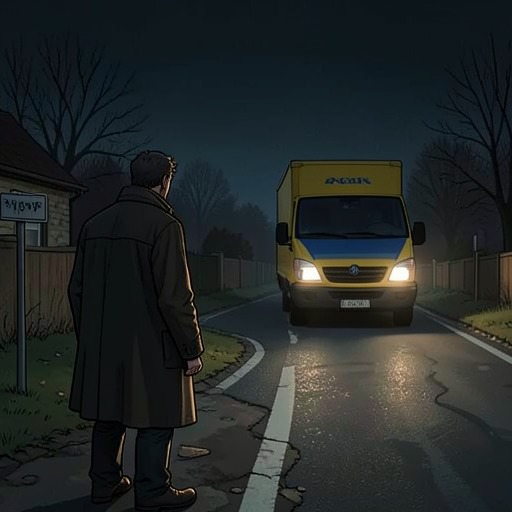
Pashka reads the message and says they should go. Before setting out, he tells Sergeyich that they may have to wait because the delivery party has only just reached Karuselino. Sergeyich is surprised that the place is in the grey zone. Pashka distinguishes the map from the situation on the ground: Karuselino is in the grey zone on the map, but in practice is controlled by the Donetsk People's Republic. He supposes that an arrangement may have been made, perhaps with payment, because everyone wants mail. The route therefore depends on getting deliveries through a contested boundary, not simply on the declaration of a quiet day.
The two men walk toward the beginning of former Shevchenko Street, now Lenin Street, where it meets the road to Karuselino. Their destination makes the ceasefire tangible: mail must travel along an actual road, through places whose official map designation and lived political control do not coincide. For Sergeyich, who says he does not need the news, the journey still holds the possibility of reading a newspaper and briefly turning his attention from private troubles. The pause promises communication without restoring the normal conditions that would make it routine.